
Home Dog boarding licence pack
Dog home boarding and day care licence pack (England)
If you board other people's dogs in your home, or run a dog day care, as a business in England, you need a licence from your council. The rules are in the Animal Welfare (Licensing of Activities Involving Animals) (England) Regulations 2018. DEFRA's statutory guidance for council inspectors sets out what each condition means in practice. It was last updated on 1 June 2026.
This pack gives you the written paperwork the guidance asks for, ready to edit with your own details. Each line shows the paragraph of the Regulations or guidance it is based on, so you can check it yourself.
Templates drafted with AI help.
What the inspector will want to see
The guidance asks for a number of things in writing. These are some of them:
- Written procedures for feeding, cleaning, transport, disease control, health checks, and the death or escape of a dog. You also need a procedure for caring for the dogs after an emergency or if the licence is suspended (Schedule 2, paragraph 9).
- A written emergency plan covering fire and heating or ventilation failure, with a plan to move the dogs out and a phone list that includes the fire service and police (Schedule 2, paragraph 10).
- A written training policy for all staff (Schedule 2, paragraph 4(3)). The guidance adds that the policy is reviewed and updated every year and that you keep a record of all staff training (guidance, section 4).
- Records kept for at least 3 years (Schedule 2, paragraph 2(2)). The guidance adds that electronic records must be backed up (guidance, section 2).
- For home boarding, a register for each dog with its dates, microchip number, owner and local emergency contacts, vet, medical history, diet, vaccinations and consent forms (Schedule 4, paragraph 17).
- For home boarding, the owner's written consent before boarding dogs from different households at the same time (Schedule 4, paragraph 13(1)), keeping a dog in a crate (paragraph 13(6)), feeding dogs together (paragraph 14) or keeping dogs together in one room (paragraph 16(1)). The guidance also asks for written consent to walk a dog outside the home and garden, off the lead, or with dogs from other households (guidance, paragraph 15.2).
A few numbers from the guidance
- Home boarding: a dog must not be kept in a crate for more than 3 hours in any 24 hours, and no more than 6 dogs can be walked at the same time.
- Home boarding: dogs must not be routinely left alone for more than 3 hours in a 24 hour period, and sleeping areas should be between 10°C and 26°C.
- Home boarding: at least 2 secure barriers between any dog and any way out of the home.
- Day care: no overnight stays, each dog needs 6 square metres of space, and each member of staff should have 10 dogs or fewer to care for.
- Both: a designated key holder who can attend in an emergency, normally within 30 minutes.
Councils give every licence a star rating from 1 to 5. Businesses with a higher rating can get a licence lasting 2 or 3 years instead of 1, so they renew less often. If you are renewing, apply at least 10 weeks before your current licence runs out.
What's inside
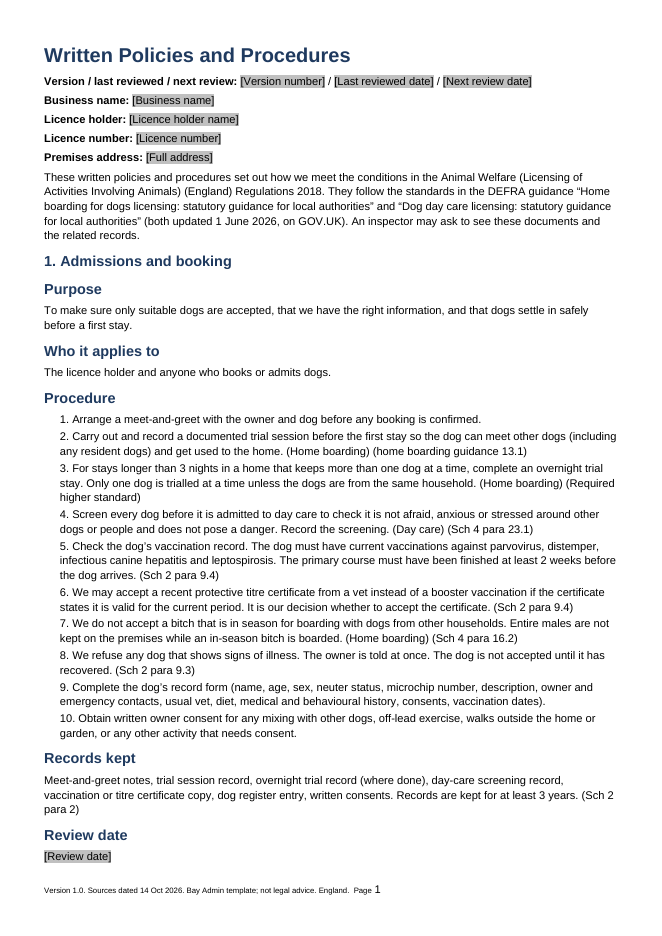
- Written policies and procedures, in 10 sections: admissions, cleaning and infection control, feeding, exercise, behaviour and new dogs, lost dog, death of a dog, transport, staff training, and care after an emergency
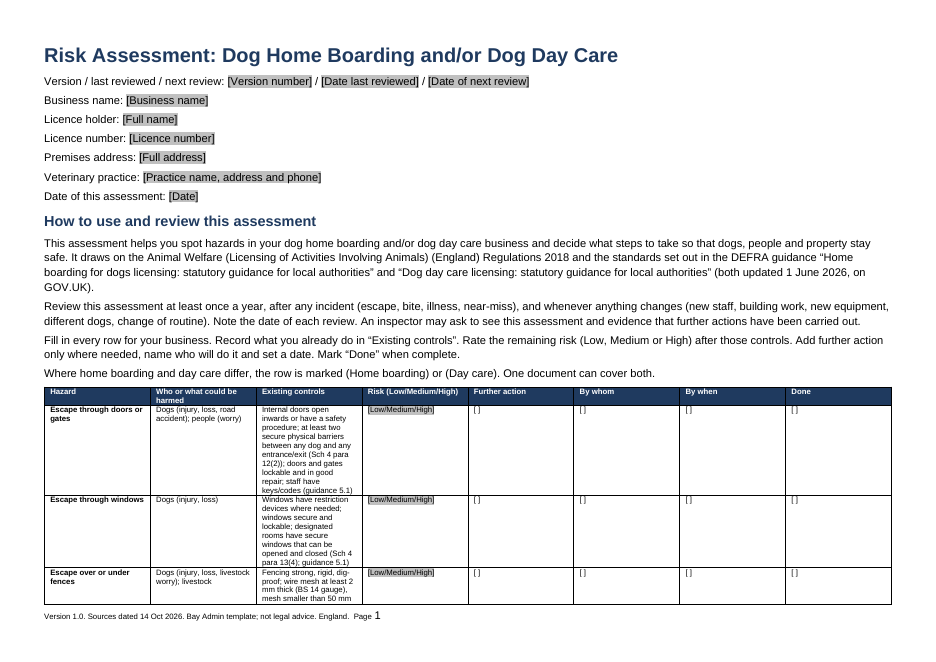
- Risk assessment covering 28 hazards
- Emergency and fire plan, with a one page summary for the door
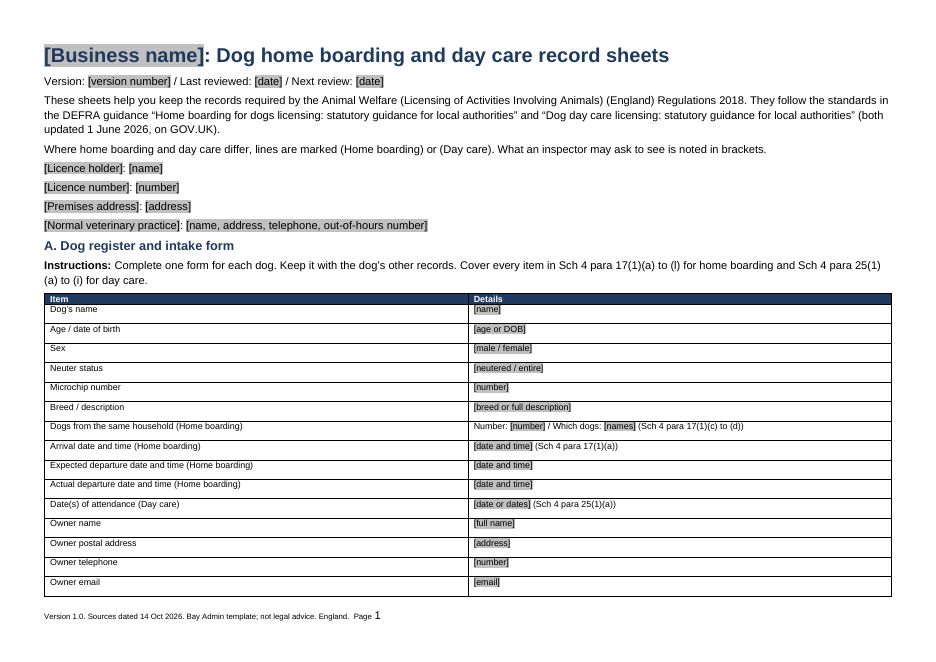
- Record sheets: dog register and intake, feeding and water, medication, incidents, daily health check, cleaning, and day care screening
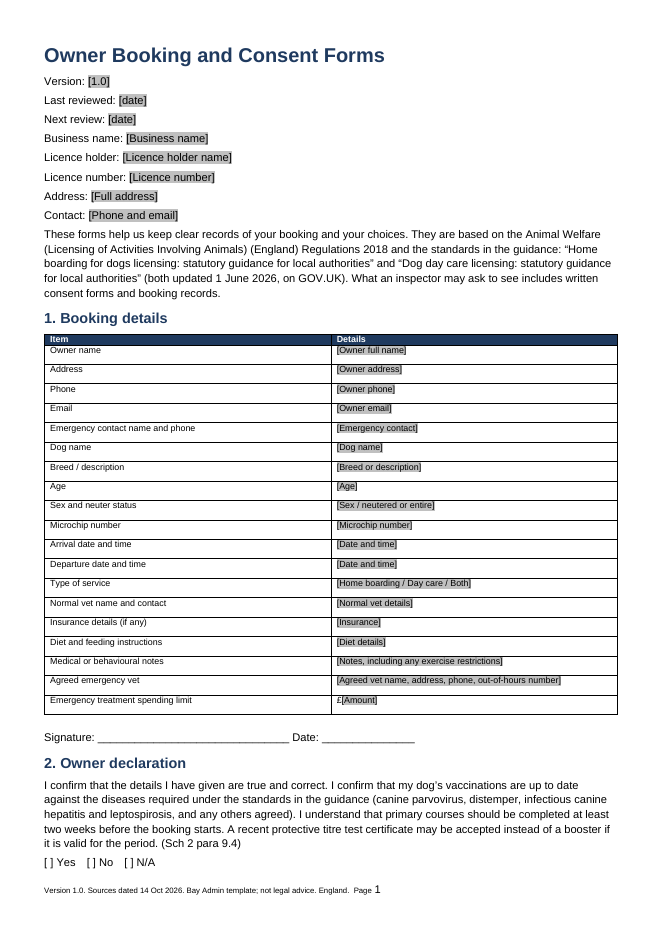
- Owner booking and consent forms
- Inspection preparation checklist
- Preventative healthcare plan: letter to your vet, for them to agree and sign
Every document comes as an editable Word file and an A4 PDF. Lines that apply to one activity are marked (Home boarding) or (Day care), so one set covers both.
Page previews
The first page of four of the documents, taken from the PDFs in the pack. Grey boxes are the places you fill in your own details.
Who it's for
Home boarders and day care owners in England who are applying for a council licence or renewing one. It is not for kennels, cat boarding or dog breeding, and not for Wales, Scotland or Northern Ireland.
This pack is not produced or reviewed by DEFRA or any council. It is not legal advice, and no template can promise a licence or a star rating. Check your own council's licence conditions and application guidance as well, because councils can add their own requirements and forms.
Price and refunds
£35, one payment. 30 day refund: reply to your receipt within 30 days of purchase for a full refund, no questions asked. This is on top of your legal rights.
Templates drafted with AI help.
Questions: hello@bayadmin.co.uk
Sources
Checked on 14 October 2026.
- The Animal Welfare (Licensing of Activities Involving Animals) (England) Regulations 2018 (legislation.gov.uk)
- Schedule 2: general conditions
- Schedule 4, Part 3: providing home boarding for dogs
- Schedule 4, Part 4: providing day care for dogs
- Home boarding for dogs licensing: statutory guidance for local authorities (GOV.UK, DEFRA)
- Dog day care licensing: statutory guidance for local authorities (GOV.UK, DEFRA)
- Animal activity licensing process: statutory guidance for local authorities (GOV.UK, DEFRA)
Contains public sector information licensed under the Open Government Licence v3.0.